Search

kim biddulph

Archaeology History Museums Schools Writing Consultancy

Category

Schools

Discover Darwin

I’m always a little daunted by the prospect of reading the classics. I don’t get on well with Charles Dickens or Thomas Hardy, though Jane Austen is my all time favourite writer. So I didn’t expect to be able to follow the writing of Charles Darwin when I first read On the Origin of Species. Amazingly, I could, and very easily. Darwin had not written a dense scientific treatise. It was a popular book intended for a very wide audience. It’s wonderfully poetic in places.

If you don’t believe me, I challenge you to read just the last chapter of the book, or even just the final paragraph if you’re that worried. The final chapter summarises the entire book, and the last paragraph is an even more succinct precis.

“It is interesting to contemplate a tangled bank, clothed with many plants of many kinds, with birds singing on the bushes, with various insects flitting about, and with worms crawling through the damp earth, and to reflect that these elaborately constructed forms, so different from each other, and dependent upon each other in so complex a manner, have all been produced by laws acting around us. These laws, taken in the largest sense, being Growth with reproduction; Inheritance which is almost implied by reproduction; Variability from the indirect and direct action of the conditions of life, and from use and disuse; a Ratio of Increase so high as to lead to a Struggle for Life, and as a consequence to Natural Selection, entailing Divergence of Character and the Extinction of less improved forms. Thus, from the war of nature, from famine and death, the most exalted object which we are capable of conceiving, namely, the production of the higher animals, directly follows. There is grandeur in this view of life, with its several powers, having been originally breathed by the Creator into a few forms or into one; and that, whilst this planet has gone circling on according to the fixed law of gravity, from so simple a beginning endless forms most beautiful and most wonderful have been, and are being evolved.”

I used this paragraph as the basis for a few lessons work on non-fiction writing for a set of lessons The Charles Darwin Trust educational consultants (including me) wrote for the London Borough of Bromley. The borough had unsuccessfully attempted to get the natural environment around Down House listed as a World Heritage Site as it was there, in Darwin’s Landscape Laboratory, rather than the Galapagos Islands or anywhere in South America, that Darwin did most of his thinking, observation and experimentation that confirmed his ideas about natural selection.
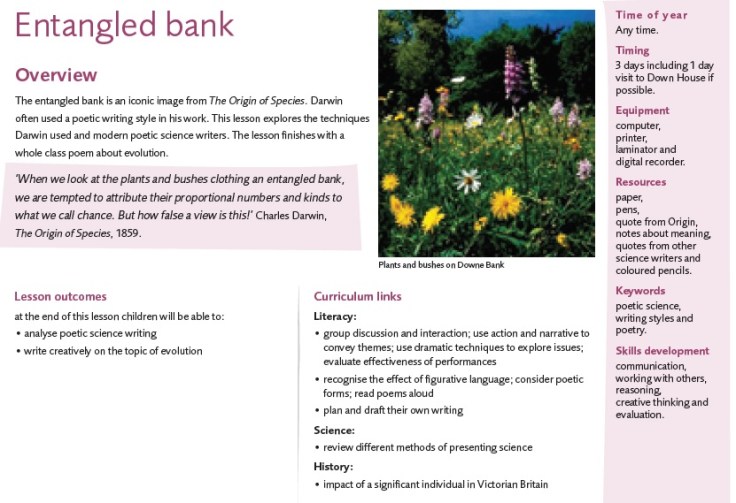
entangled bank

I contrasted Darwin’s writing with that of modern science writers such as E.O. Wilson and Richard Dawkins (in hindsight I should have included some female science writers). I wanted to get across the idea to children that writing in science doesn’t have to be impenetrable and that by writing in an engaging and even poetic way, it can bring science to a wider audience.
Milton Keynes Late Roman coin hoard in schools

I tell the story of the coin hoard being buried in AD 353 and rediscovered in 2006 elsewhere on my blog. The nature of the coin hoard, with coins of the usurper Magnentius, makes a fantastic story as well as the opportunity to introduce how knowledge of the past is constructed and look in detail at the imagery and inscriptions on Roman coins.

The hoard is now in the Buckinghamshire County Museum who applied to the Heritage Lottery Fund to make the hoard more accessible, which included putting up temporary displays in Milton Keynes schools, writing lesson plans for teachers to use and having a costumed Roman visit schools to cement interest in the topic.

I was keen to support maths teaching, which now includes learning Roman numerals, and provided some optional maths activities about timelines, coin values and work on percentages and averages based on the information on the 1456 coins. The museum wanted to use the coins to explore the movement of people and ideas so I also created activities about the various mints across the Roman Empire and the spread of Christianity for instance.

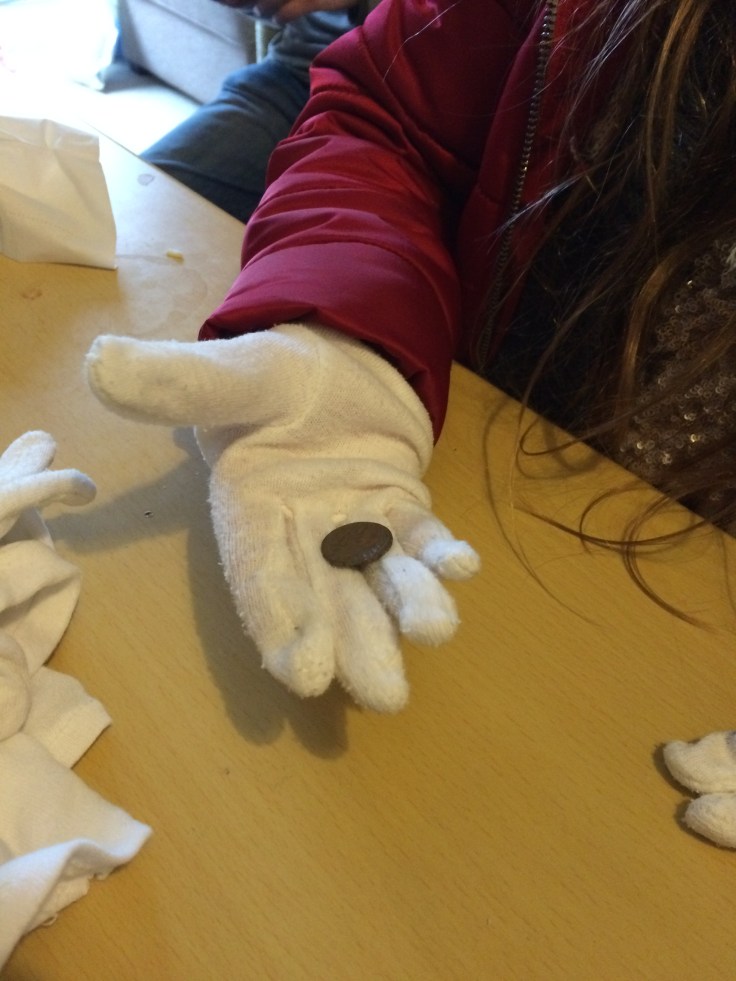
The school visit entails acting out the story of Magnentius’ attempted coup and then getting to handle some of the coins from the hoard. I’m not sure which part of the day the kids enjoyed best, fighting in a pretend Roman army or actually holding real Roman coins.

IMG_7898

Teaching teachers about Darwin and evolution

The new Key Stage 2 curriculum has brought in various new topics, including teaching evolution in Year 6 science. Previous to this primary school biology had included variation and adaptation, the cornerstones of evolution, but not explicitly required teachers to teach Darwin’s theory. The non-statutory guidance also mentions learning about famous figures in the history of evolutionary biology including Mary Anning and Alfred Russell Wallace alongside Darwin himself.

A colleague, Ewa Prokop who is Mad About Charles Darwin (literally), wrote a children’s book about Darwin and his work (Darwin’s Wild Pursuits), exploring some of the aspects of evolution through imagined conversations he has with creatures he meets on his perambulations in the countryside around his home in Kent, Down House, where he spent the last 40 years of his life. I particularly like the last story about the orb-weaving spider who tells Darwin that one of her sisters on suffering an accident that meant she could no longer make a web learned how to hunt on the ground instead. I’m quite fond of spidery tales.

IMG_8186Ewa put together a plan to run some teacher training on evolution in Yeovil Country Park, a wonderful setting, with their rangers. I went and co-delivered that recently. Along with Ewa’s book, a precis of Darwin’s life and work (which is often misunderstood) and the steps in his theory of evolution I demonstrated a number of possible activities teachers could do with children that Darwin himself did. I was pleased to note that several of the teachers had come across the blocks I wrote on Darwin and Anning for the Hamilton Trust.

The Charles Darwin Trust, one of the organisations whose umbrella I work under, identified certain ways of working that were typical to Darwin, though not confined to him, including using everyday materials to conduct simple experiments; talking to many other people, not just scientists, about their particular expertise; and close, frequent and sustained observation of certain habitats. His method is quite accessible to primary aged children.

Experiments included wrapping unopened flower buds with kitchen muslin (with quite an open weave) to see what effect preventing insects visiting will have on the flower; taking pond mud and seeing what grows from it; and feeding carnivorous plants toenails and hair. Another simple experiment involved eating several ‘purple ones’ from a certain chocolate box (I suffer for my work, I really do!) and using the cellophane wrapper to simulate the ultraviolet eyesight of bees. If you hold them up against certain flowers (we tried celandine and wood anemone) you can see the darker markings that are not otherwise visible to our eyes that guide bees towards the nectar. Work by a team at the University of Arizona have found that this reduces the amount of nectar robbing that bumblebees undertake and so is a very successful strategy for flowering plants. This demonstrated, in a very Darwinian way, that there has been work on evolution since Darwin. This is especially important because the guidance in the national curriculum suggests not mentioning genetics.

The rangers also showed how teachers can very simply sample the environment at Yeovil Country Park with sweeping nets, tree beating and pond dipping so that children can get closer to nature, observe the animals and plants around them and start to make their own observations.

How do we know about the past?

I often think of what types of sources are used to make the stories about the past on various dodgy websites. Since I’ve been working for the Hamilton Trust I have become more aware of how many websites and books offer information and resources for teachers that don’t quote where they got their information from (even the BBC). Of course, many primary school teachers will not have studied history past the age of 14 themselves, so will not know the information, let alone have the historical skills to find out.

Not only do teachers often not know and don’t have time to find out where the information comes from, how can children (and I quote from the national curriculum) “understand how our knowledge of the past is constructed from a range of sources” if the teachers have no idea? Critical thinking skills get such high billing in the science or English curriculum, they should be there in the history curriculum too.

I tend to write blocks of work on the evidence behind the various topics I write about e.g. the Shang Dynasty of China, Ancient Greece or, currently, Benin in West Africa from AD 900-1300. I built in a discussion about sources for prehistory in the workshop I developed for the Pitt Rivers Museum (particularly as it is an anthropology museum and I wanted to show that ethnographic parallels are a frequently used, if sometimes contested, alternative source of evidence to interpret archaeological sites and artefacts). When I go out to schools to talk about Anglo-Saxons I get kids to act out the invasion according to Bede, and then pick holes in the evidence as provided by archaeology.

I have found writing about the sources of evidence for Benin’s pre-colonial history quite a challenge. Websites and books merely told the stories of various Ogisos and Obas, and the possible invasions from Ile-Ife that either they got from another website or book without references, or they assumed you knew what the main sources were.

Finally, I found several almost primary sources. Firstly, those stories about the Ogisos and Obas come from the oral histories that were told for centuries in Benin (now in south-west Nigeria, not the site of the current Republic of Benin) and written down and published in 1933 by Jacob Egharevba. If you have an account with Questia, you can read it online. But how far can we trust the oral histories that may have been reworked several times?

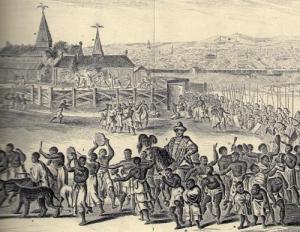
Benin_City__ca__1600
Benin City by D O Dapper, Public Domain, via Wikimedia Commons.

Secondly, there are the accounts by Europeans about what Benin was like after the period in question. There’s Olfert Dapper who published in 1668 (and hadn’t visited so based all his information on reports from others), Olaudah Equiano claimed to have grown up in Benin before being sold into slavery at the age of 11, but he may have been born in the Americas, and Sir Richard Burton wrote about the kingdom and other areas of West Africa during a journey in 1862. But what can the writers of these later centuries tell us of the pre-European period? Surely the mere contact with Europeans changed the society hugely, plus it’s written by outsiders who have particular agendas.

Thirdly, there’s archaeology. Not a lot of archaeology has been done in the kingdom of Benin but there is one article I found in the The Journal of African History by Graham Connagh dating back to the 1960s where he dug on the site of the former Oba’s palace and some of the levels dated back to the 13th century AD (you can find it on JSTOR). But I didn’t find any other articles on the archaeology of the kingdom of Benin. Do please point me their way if you know of any!

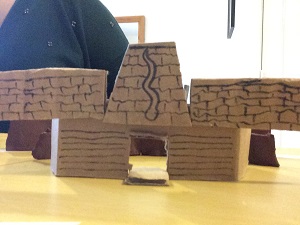
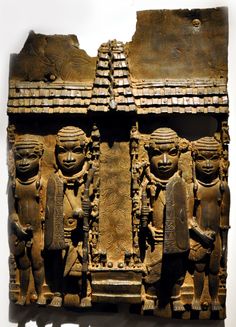
Having taken the teachers and children through these various sources of evidence, I am challenging them to recreate Benin City using the various rsz_IMG_8047sources. Here’s my recreation of part of the Oba’s palace based on one of the Benin bronze plaques now in the British Museum below.
b1f3d5f3bb358020053461df0c8cd62b
Jaymz Height-Field at the French language Wikipedia CC-BY-SA-3.0 (http://creativecommons.org/licenses/by-sa/3.0/), via Wikimedia Commons


Children will have to decide whether to focus on pictorial evidence, written descriptions or archaeological discoveries, especially where they contradict each other. It’ll be interesting to see whether any of them think about focusing on one particular time in the Kingdom of Benin’s history. The evidence I have provided for this task ranges from the 12th to the 19th centuries AD. Did the city stay the same during this period? I hope there’ll be plenty of discussion (perhaps even arguments) about the reliability and validity of the evidence as classes build their models of Benin City.

Late Roman rebellion

In 2006 two metal-detectorists found a hoard of Roman coins near Milton Keynes. Archaeologists were notified and the site was excavated, and it was thought that the coins were probably buried in a pot in a rubbish heap. The coins were not particularly valuable, they were all bronze, but there were 1456 of them. They were reported as treasure the are no in Buckinghamshire County Museum.

What is fascinating about these coins is the story they tell. The coins date to the 4th century AD, mostly around AD 350. There are a couple of coins of Constantine the Great (the emperor who made Christianity the state religion of the Roman Empire) but many more from the reign of his sons, Constantine II, Constantius and Constans (Roman emperor’s baby name books weren’t very imaginative).

A century before this the emperor Diocletian reorganised the empire into two zones, the Western and the Eastern Empires. There was an over-emperor or Augustus who generally controlled the Eastern Empire and a junior emperor or Caesar who controlled the Western Empire. When Constantine the Great died, his three sons split the territories between them. They bickered, though, as you’d expect, and it eventually came to blows. In a battle between Constantine II and Constans, the former was killed.

Things stabilised for a while, but then Constans is said to have got very cruel and preferred the company of his barbarian bodyguards that his generals. One of these, a man called Magnentius (who is said to have had a Frankish mother and a British father) decided to make himself Augustus and Caesar and sent someone to dispatch Constans.

Eventually, Magnentius and the one surviving son of Constantine the Great, Constantius, fought. Their armies met in Dalmatia and in Frankia and eventually Magnentius was defeated and he killed himself. Constantius is supposed to have sent a servant called Paulus to Britain to punish anyone who supported Magnentius, and he got the nickname Paulus Catena or Paul the Chain for dragging people through the streets in chains.

The coins in the pot found by the metal-detectorists near Milton Keynes in 2006 were mainly coins of Constantius, Constans and Magnentius. Perhaps the owners of these coins buried them in a panic generated by Paulus Catena’s antics.

IMG_7899
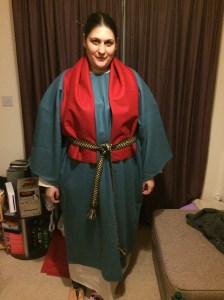
Me at home in my late Roman outfit

Brett Thorn at the Buckinghamshire County Museum asked me to write some teacher’s material to go with the coins as part of a tour of part of the hoard to schools in Milton Keynes. I was also to devise a session where I would go in to the school in costume and let kids handle some coins from the hoard.


I did my first one yesterday, and it went really well. We told the very complicated story of the rebellion and burial of the coins in the hall, along with cardboard swords, laurel wreaths, purple robes and paper chains. I involved every single child from two classes in telling the story, which helped bring it to life. Later the kids remembers which friends had been Magnentius, Constans and the others.

The kids loved handling the coins, and already knew that they had to wear gloves to protect the coins from the acidic oils on their hands. I worked with a small group at a time to handle the coins, and took some Roman games to try out for the rest of the class to play while they waited.

Sports history

I’m writing about cricket history at the moment for a topic on sports history and tournaments for the Hamilton Trust. I came across a very interesting article on several newspaper websites, including reputable ones, suggesting that the earliest reference to cricket may not have been in England as once thought, but in France.

Apparently an agent of the throne, a young man called Estiavannet, wrote to King Louis XI of France in October 1478 about being shouted at by a group of men in Liettres in northern France for staring at their game of ‘criquet’. Apparently, it might be ‘croquet’, in which case, the English still have it.

Despite all this detailed information with names, dates and locations, I have not been able to find a primary source at all. I found out it resides in the Archives Nationales in Paris and contacted them, scoured their online collection database, but to no avail. If anyone has any leads, please let me know!

Trace fossils

I volunteered for the Oxford University Museum of Natural History yesterday on one of their Dino Days that they do for Year 7s. I wanted to remind myself what secondary school students were like, plus I’m fond of dinosaurs. It was a great day.

I was helping with casting dinosaur footprints and other fossil casts with plaster of paris. One of the conservators had made silicon moulds for the job, and the kids had to follow instructions to mix the plaster and pour it into the moulds. While it hardened, they found out a bit more about trace and true form fossils.

I’m particularly fond of trace fossils, from coprolites (fossilised faeces) to footprints to skin impressions. I wrote a block of work on trace fossils, the study of which is called ichnology, for the Hamilton Trust. While the conditions for fossilisation for both true form and trace fossils are similar, there is so much more potential for greater numbers of trace fossils than true form, since every single dinosaur could have left thousands of footprints or specimens of faeces behind, but only one body.


A large coprolite (fossilized feces or dinosaur poop) from South Carolina, USA..jpg
A large coprolite (fossilized feces or dinosaur poop) from South Carolina, USA.” by PoozeumOwn work. Licensed under CC BY-SA 4.0 via Commons.

One of my favourite finds for the block I wrote was a quarry in Bolivia where thousands of dinosaur footprints have been found. Due to the movement of the earth’s crust since the time of the dinosaurs, these now appear to be walking vertically up the wall.

Dinosaur tracks in Bolivia 1.jpg
Dinosaur tracks in Bolivia 1” by Jerry Daykin from Cambridge, United KingdomFlickr. Licensed under CC BY 2.0 via Commons.

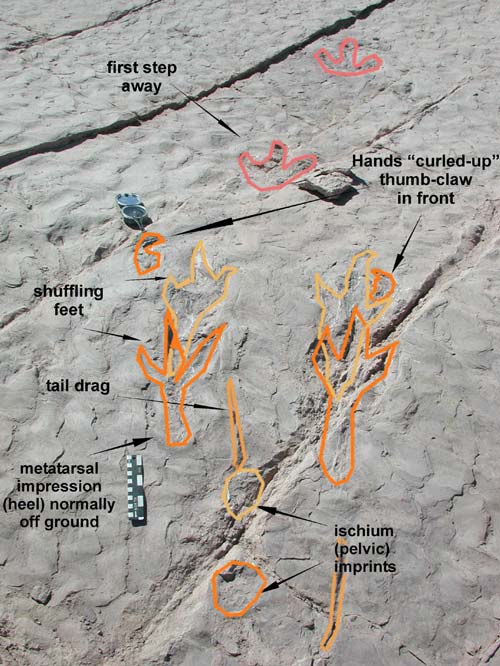
I also like this one where the dinosaur had clearly sat down and then moved away again, found at a farm in Utah.

tracks_lg
Squatting dinosaur tracks at Johnson’s Farm in St George, by Nancy Carruthers, Utah Geological Survey

Early and modern humans have also left tracks (though not in the same strata as dinosaurs as some would have you believe) like the famous ones at Laetoli in Tanzania (probably 3.7 million years old and belonging to Australopithecus afarensis), but also at Happisburgh in the UK (about 800,000 years old and possibly Homo antecessor) and modern humans, Homo sapiens, around 7000 years ago at Monte Hermoso in Argentina. What better way to get children to engage with what these footprints can tell us (height, gait, speed) than by getting them to make dinosaur feet, dip them in paint and run across paper with them, or make their own footprints in wet sand and fill them in with casting material?

Blog at WordPress.com.

Up ↑