I don’t want to use the J word, but I have been deleting old emails recently and it reminded me about the way my freelancing career has developed over the years.
At first it all started as an extra to full time work. I left English Heritage to work at the London Borough of Camden on a Heritage Lottery Funded project, but I was keen to continue to do something in association with the Charles Darwin Trust and, as it turned out, they wanted that too so I started to do some writing and teaching work with them. During the bicentenary of Darwin’s birth and 150th year since the publication of Origin, 2009, I was very busy with work for them as well as work for Camden. It quietened down a little in 2010, and then got quieter still after that, and I had a new baby which also reduced the amount I could do.
I eventually moved from the London Borough of Camden to another employed role at the Pitt Rivers Museum and freelancing went by the wayside. After the maternity cover contract ended I decided to go it on my own. The costs of childcare while working full-time were too onerous and I wanted to spend more time with my little one. At first I trained to be a childminder and managed three months of this. Childminding is not an easy job, let me tell you. I was more tired doing that than any other job I have had, and I have worked as a field archaeologist, in the catering industry and now visit schools to do days of teaching, all of which are tiring but not like childminding. So I looked for other things.
All of a sudden, I found things. I had experience of writing for teachers through English Heritage and the National Museums Online Learning Project so a friend introduced me to a friend who had set up a business called Plan Bee. She needed a history specialist to write lesson plans and resources for the new curriculum so I took that on, writing lesson plans on the Prehistory of Britain, the Shang Dynasty of China, and the Kingdom of Benin, for instance. With this experience under my belt I approached the Hamilton Trust, on the advice of another friend, and said I could write their Prehistory of Britain topic. I found the Hamilton Trust work much more in depth and I still write for them, just recently having finished a recap of all British history for a post-SATS topic for Year 6s.
At the same time I had applied for two local jobs. One was as a secretary for my village’s Neighbourhood Plan at £10 an hour and this lasted for over a year with me working mainly in the evenings. I also applied to be a workshop leader at the Chiltern Open Air Museum and I work there still on a zero-hours contract mainly teaching schools but also families and home ed groups. I also volunteered for Kids in Museums and an opportunity came along to take over organising their workshops on working with families and young people.
I set up Schools Prehistory in order to get information out to teachers for the new topic in primary history, as it is my specialist subject, and I think on the back of that was approached by a contact from the British Museum (which was part of the National Museums Online Learning Project that I had written for) to apply for a job as a writer on the Teaching History in 100 Objects website that the DoE had funded to support the new history curriculum across Key Stages. I wrote about lots of objects for them from Late Bronze Age logboats from Must Farm to a cloth celebrating Ghanaian independence from 1957.
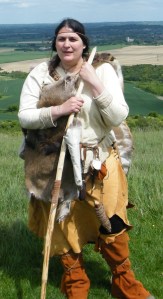
I also started marketing myself as a time travelling visitor with Schools Prehistory to schools and still visit schools across the south-east and midlands as a Stone Age, Roman, Saxon of Viking woman or as an archaeologist, sometimes with colleagues and sometimes on my own. I had difficulty in selling lesson plans through my own website so now they can be downloaded if teachers sign up to my newsletter.
As a time traveller, and for the purpose of developing a Mesolithic workshop at the Chiltern Open Air Museum, I developed some bushcraft skills and so my latest venture has been to set up 500 BC. I asked the Forestry Commission, who look after Wendover Woods near me, whether I could work on their site and duly applied for a licence to do so and now run toddler groups, home ed courses, family and adult bushcraft days, holiday clubs, school visits and team-building workshops. I am expanding to other sites and to sub-contracting.
I have also tendered for shorter freelance contracts conducting market research with families, or devising and piloting schools workshops but have not had much luck with those. Where I have been successful it’s usually through recommendations and word of mouth.
This isn’t meant to be a self-congratulatory post. I wanted to show how I built my freelancing portfolio, which is a little unusual, but has all the elements of how to be successful at freelancing whatever field you’re in.
- Network. Having a good network that you stay in contact with via social media and attending sector events is essential.
- Don’t be afraid to approach people cold. Before you do this you have to do your research and be sure that they want something only you can offer.
- Create your own opportunities if you can – apply for funding, see a need in the market you can fulfill.
- Collaborate. Find like-minded people you can sub-contract to (you’ll need employer’s insurance) or pass work to, and they will hopefully pass some back.
- Try to have a couple of relationships that bring in a regular income and supplement them with shorter contracts. Then when you need to find the next job, you still have a little work and money to tide you over (I can’t say I’m very good at saving!)
- Be flexible. Not everything you will end up doing is going to totally rock your world. As you get more confident and busier, you will be able to say ‘No thanks’ to those contracts that don’t totally float your boat.
- I hate saying this, because it’s not something I love doing, but you will need a brand. Either that’s your name or a trading name that will represent you. As you can see, I have a couple of different ones for different strands of my work.
- If something doesn’t work, learn from it and move on.
- Keep at it!
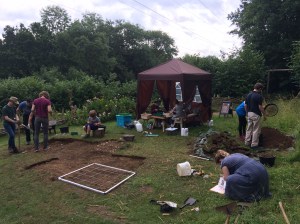 In July 2017 I ran a small excavation for families at the
 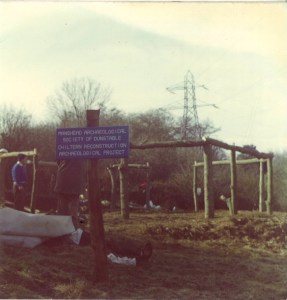 I was lucky that there were extensive photographs (those old square slightly brown-tinged 1970s style – see right) of the original build which helped to prepare the families for what we might find including the remains of a turf wall and some big post-holes. What is also really useful is having some of the original builders of the house still working at the museum, though they couldn’t remember whether we would find a cobble or rammed chalk floor, as have been used in the new roundhouse.
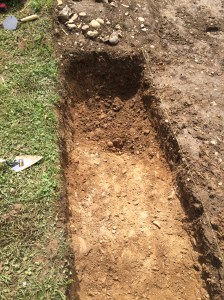 A small trench was opened over the area where I thought the turf wall might have been, and I hope to hit at least one post-hole, and over a lump that would be inside the house. We found a wooden post under the surface, not big enough to be an abandoned post from the house, and the lump was a small dump of flint cobbles – which also housed an ant’s nest to was abandoned immediately. John Hyde-Trutch, the buildings manager at the museum, remembered leaving a heap of flint cobbles behind after the dismantling of the old house, and that a fence was built along the line of the old turf wall – the source of the wooden post.
 Dating evidence for the house was found in the interior, in the form of a twenty pence piece from 1994 and a Stella Artois bottle cap! A broken pencil and pencil lead that refitted, and a stray plastic gemstone also gave us an idea that the house might have been used for educational and family activities.
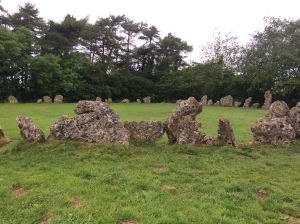 On August bank holiday in 2017 I was privileged to be asked to be a Neolithic woman at the Rollright Stones in Warwickshire. The Rollright Stones are made up of several monuments that may have been erected over several hundred years in the Neolithic and potentially early Bronze Age too. There is a stone circle, the remains of the stone chamber of a long barrow, also known as the Whispering Knights, and a lone standing stone, the King stone, which is now across the road from the rest. There is a wonderful legend about the stones about the king being tricked by a witch and his whole host being turned to stone.
 I’ve been practising HEMA (historic European martial arts) for a couple of years now (i.e. not very long) and have tried my hand at sword and buckler, longsword (that’s me with a nylon longsword on the right) and backsword. All of these types of swordplay have manuals from about 1300 AD onwards to help us work out what people were doing with them at the time they were used. Of course, their use would have varied depending on whether they were used in judicial fights, duels or by soldiers in an army. What I hadn’t fully realised until recently was that each sword demands slightly different play partly because they all have different defences for the hands.
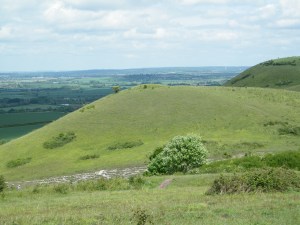 The other issue that came up was the authenticity of the Ridgeway and the related Icknield Way. A whole heritage industry has built up around the idea that these were long distance routeways from the Neolithic onwards but the evidence is less than compelling. It has become an axiom repeated again and again with little reflection or reference back to its origin myth in Henry of Huntingdon’s Historia Anglorum. The article I encountered a few years ago, “The Icknield Way – Some Queries” by Sarah Harrison in the Archaeological Journal, had clarified some of this for me and I felt that I couldn’t in all conscience perpetuate this legend.
 It felt good to do research again when doing this walk. I had a good sense of what I wanted to say but I went back to the sources to get the specifics. The original excavation of Ivinghoe Beacon in the 1960s was reported in Records of Buckinghamshire and, though referenced by later articles, one aspect was never again mentioned, and that is the recovery of a trepanning disc from a human skull that had been turned into a pendant. Imagine my delight! I promptly made one myself (from a sheep shoulderblade though!) I got some good reactions from that.
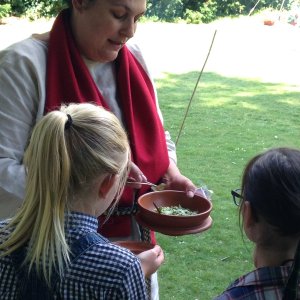 We started with a salad from Columella, which involved crushing salad leaves with chopped leek and soft white cheese (feta is good). Mixing in some vinegar with peppercorns crushed in a mortarium added a bit of a bite.
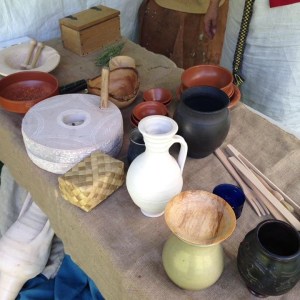
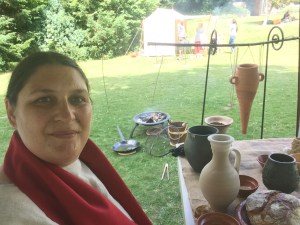 The table and storage wares were used for their original purposes, from grinding food on mortaria, to storing dates in a carrot amphora, and drinking mulsum (a spiced wine but we used grape juice) from little Samian cups poured from an authentic flagon.

 kim biddulph