Following interesting discussions on Facebook and Twitter with colleagues from the archaeology sector about the perceived leaky pipeline for women (i.e. lots of women studying archaeology at university – not so many in management positions in the profession) I decided to look at the publicly available data covering the gender pay gap. Organisations that employ 250 people and more are obliged to publish data on pay for men and women employees under the Equality Act 2010 (Gender Pay Gap Information) Regulations 2017 which came into force on 6th April 2017.
This obliges these larger organisations to publish the difference between the mean and the median hourly rate of “male full-pay relevant employees and that of female full-pay relevant employees”. It also requires them to publish the proportions of male and female full-pay employees in the lower, lower middle, upper middle and top quartile pay bands. What the intention is to see whether men and women are paid the same rate for the same work, and whether women are represented in the upper pay bands at the same proportion as men. A “full-pay employee” does not mean a full-time employee but “a relevant employee who is not, during the relevant pay period, being paid at a reduced rate or nil as a result of the employee being on leave”. Overtime is not included. Bonuses are reportable, but are not included here as they are not routinely used in this sector.
There are three commercial archaeology companies who would qualify (according to the Institute for Archaeologist’s Yearbook detailing numbers of employees in 2017), Oxford Archaeology (OA), Wessex Archaeology and Museum of London Archaeology (MoLA). I could only find the gender pay reports for the first two. MoLA may have reported as part of an umbrella organisation, I guess.
I also decided, as I work in museums and heritage myself, to see if I could find other organisations who had reported. I found the British Museum (BM), National Maritime Museum (NMM), the National Gallery (NG), the National Trust (NT), the National Archives, and the National Portrait Gallery (NPG).
The first table below shows a comparison between all of these organisations in where women’s pay sits above or below the mean and median hourly rate in 2017.
| OA | Wessex | BM | NMM | NT | Archives | NG | NPG | |
| Mean | -5.20% | -6.90% | 0.00% | -2.30% | -12.80% | -1.10% | -14.40% | -8.30% |
| Median | 0.00% | -2.10% | 4.00% | 0.50% | -14.40% | 2.00% | -15.20% | -13.10% |
The national average gender pay gap in median hourly rate was 9.1% in 2017. The National Trust and National Gallery and National Portrait Gallery therefore have a greater gender pay gap than the national average, whereas all the other organisations do not.
Now let’s look at the percentage of women in each quartile of pay bands in each of these organisations.
| OA | Wessex | BM | NMM | NT | Archives | NG | NPG | |
| Top | 37.00% | 41.00% | 57.00% | 60.70% | 55.00% | 46.70% | 62.00% | 61.40% |
| Upper middle | 36.00% | 46.00% | 61.00% | 54.80% | 63.00% | 53.30% | 64.00% | 65.50% |
| Lower middle | 38.00% | 44.00% | 58.00% | 51.90% | 72.00% | 56.00% | 79.00% | 65.50% |
| Lowest | 49.00% | 50.00% | 49.00% | 61.50% | 72.00% | 42.00% | 79.00% | 79.80% |
This is really revealing, as in the museums (BM, NMM) and galleries (NG, NPG) and the National Trust, women outnumber men at all pay levels. You will not that in many of these organisations there is a tail-off so that the percentage of women at upper levels is lower than those in the least well paid quartiles. The British Museum is slightly different, in that it is only in the lowest quartile that women and men are virtually even, and then the percentage of women is higher in each of the higher pay quartiles. The National Archives is also an interesting case where women outnumber men in the middling pay quartiles but not at the bottom or top.
And then we get to the archaeology companies (OA and Wessex). From virtually even numbers of men and women at the lowest pay quartile the numbers of women drop off alarmingly in the upper pay quartiles, arguably the ones that don’t entail working in the field as much. Oxford Archaeology, in it’s report on its own website, has committed to determining what the barriers to progression for women are. Interestingly, of course, OA’s CEO is a woman, Gill Hey. Chris Brayne of Wessex Archaeology has also published some objectives for his company to combat the lack of women in upper pay grades.
What are your thoughts? Do you have experiences to share in either archaeology, museums, galleries or heritage? Are things moving forward?
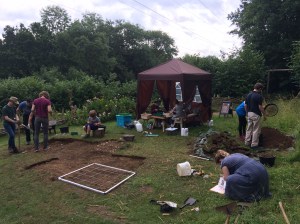 In July 2017 I ran a small excavation for families at the
 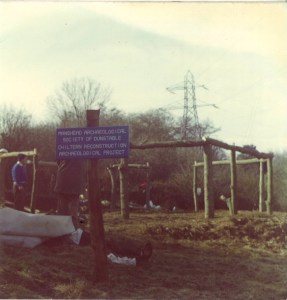 I was lucky that there were extensive photographs (those old square slightly brown-tinged 1970s style – see right) of the original build which helped to prepare the families for what we might find including the remains of a turf wall and some big post-holes. What is also really useful is having some of the original builders of the house still working at the museum, though they couldn’t remember whether we would find a cobble or rammed chalk floor, as have been used in the new roundhouse.
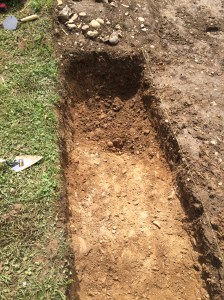 A small trench was opened over the area where I thought the turf wall might have been, and I hope to hit at least one post-hole, and over a lump that would be inside the house. We found a wooden post under the surface, not big enough to be an abandoned post from the house, and the lump was a small dump of flint cobbles – which also housed an ant’s nest to was abandoned immediately. John Hyde-Trutch, the buildings manager at the museum, remembered leaving a heap of flint cobbles behind after the dismantling of the old house, and that a fence was built along the line of the old turf wall – the source of the wooden post.
 Dating evidence for the house was found in the interior, in the form of a twenty pence piece from 1994 and a Stella Artois bottle cap! A broken pencil and pencil lead that refitted, and a stray plastic gemstone also gave us an idea that the house might have been used for educational and family activities.
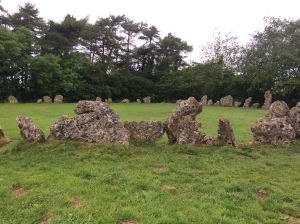 On August bank holiday in 2017 I was privileged to be asked to be a Neolithic woman at the Rollright Stones in Warwickshire. The Rollright Stones are made up of several monuments that may have been erected over several hundred years in the Neolithic and potentially early Bronze Age too. There is a stone circle, the remains of the stone chamber of a long barrow, also known as the Whispering Knights, and a lone standing stone, the King stone, which is now across the road from the rest. There is a wonderful legend about the stones about the king being tricked by a witch and his whole host being turned to stone.
 I’ve been practising HEMA (historic European martial arts) for a couple of years now (i.e. not very long) and have tried my hand at sword and buckler, longsword (that’s me with a nylon longsword on the right) and backsword. All of these types of swordplay have manuals from about 1300 AD onwards to help us work out what people were doing with them at the time they were used. Of course, their use would have varied depending on whether they were used in judicial fights, duels or by soldiers in an army. What I hadn’t fully realised until recently was that each sword demands slightly different play partly because they all have different defences for the hands.
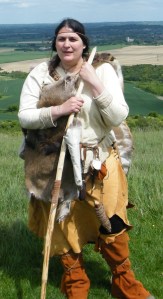 Back in May I led an archaeology themed guided walk along part of the Ridgeway National Trail at Ivinghoe Beacon as part of the Chiltern Walking Festival. I was dressed as a Stone Age woman all in skins and fur but I covered the archaeology of all prehistoric periods at Ivinghoe Beacon and the surrounding area. I brought along some replica artefacts for people to connect with as we walked and tried to build up a period of a changing landscape from the Ice Age to the Iron Age.
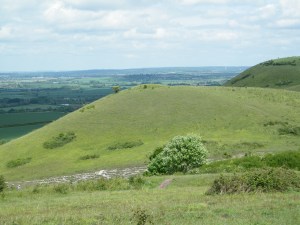 The other issue that came up was the authenticity of the Ridgeway and the related Icknield Way. A whole heritage industry has built up around the idea that these were long distance routeways from the Neolithic onwards but the evidence is less than compelling. It has become an axiom repeated again and again with little reflection or reference back to its origin myth in Henry of Huntingdon’s Historia Anglorum. The article I encountered a few years ago, “The Icknield Way – Some Queries” by Sarah Harrison in the Archaeological Journal, had clarified some of this for me and I felt that I couldn’t in all conscience perpetuate this legend.
 It felt good to do research again when doing this walk. I had a good sense of what I wanted to say but I went back to the sources to get the specifics. The original excavation of Ivinghoe Beacon in the 1960s was reported in Records of Buckinghamshire and, though referenced by later articles, one aspect was never again mentioned, and that is the recovery of a trepanning disc from a human skull that had been turned into a pendant. Imagine my delight! I promptly made one myself (from a sheep shoulderblade though!) I got some good reactions from that.
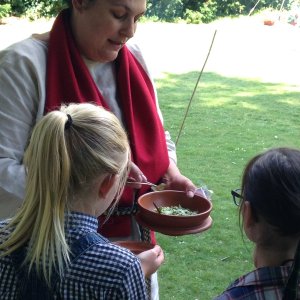 We started with a salad from Columella, which involved crushing salad leaves with chopped leek and soft white cheese (feta is good). Mixing in some vinegar with peppercorns crushed in a mortarium added a bit of a bite.
 We finished with another from Apicius which was boiled ostrich! The sauce involved making a roux from red wine and flour, and then adding vinegar and garum as well as crushed coriander seeds and dates. This was, perhaps, the most popular dish.
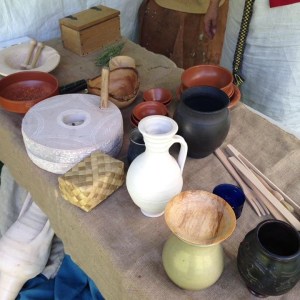
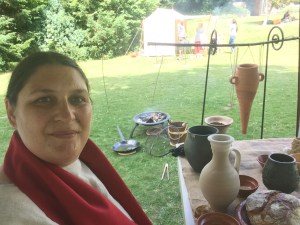 The table and storage wares were used for their original purposes, from grinding food on mortaria, to storing dates in a carrot amphora, and drinking mulsum (a spiced wine but we used grape juice) from little Samian cups poured from an authentic flagon.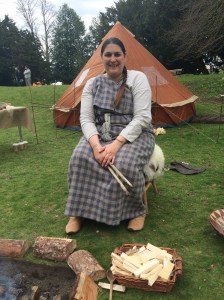

 As you may know, I have a podcast on the Archaeology Podcast Network all about stories set in prehistory. The Network has so many podcasts about various different aspects of archaeology to listen to and is just growing and growing. Each episode of my podcast is an hour long, and I know that’s a big commitment to listen to, so why not try out a bitesize podcast, from five to fifteen minutes each, every day for 2017? I bet you’ll be hooked by February.
 kim biddulph