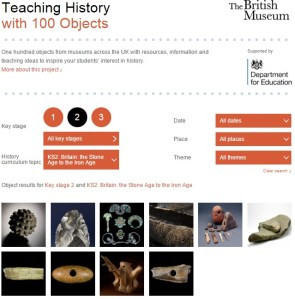
The British Museum was commissioned by the Department for Education to create resources for the new history curriculum at Key Stage 2 and 3, Teaching History in 100 Objects. The format was similar to the radio series by the museum’s director, Neil MacGregor, A History of the World in 100 Objects. In reality these 100 objects were just jumping off points for finding an infinite array of objects to use in the classroom.
I wrote all the object files for the new area of the Key Stage 2 curriculum, Changes in Britain from the Stone Age to the Iron Age. Some of these objects are really iconic to archaeologists so it was very excited to be able to write about them.
It was very interesting to work out what the big messages embodied in the objects were, rather than explain it from an archaeological perspective. The red deer frontlet headdress from Star Carr, for instance, stood for the rich and complex culture and belief systems of the early Mesolithic hunter-gatherers. A saddle quern from Wales reflected the change to farming and the important role of women (presumably the ones who used the querns to grind grain, though I’m happy to be challenged on that interpretation) in the Neolithic.
Doing this work also introduced me for the first time to the Must Farm excavations, which are ongoing. The earlier excavations uncovered eight scuttled logboats dating from the Late Bronze Age and Early Iron Age, preserved in the waterlogged mud of an ancient riverbed. I was very lucky to go and visit the more recent excavations of a roundhouse that had been preserved by conflagration and then submergence in the same water, a little downstream.
I also wrote about Anglo-Saxon, Pictish and Scottish objects for the Key Stage 2 curriculum and a selection of later objects for the Key Stage 3 curriculum, including a demi-culverin cannon from the Mary Rose, a banner of the Jewish Baker’s Union, a burned Second World War ID badge belonging to Thelma Barlow of the Parnall’s Aircraft Factory (she survived, thankfully) and a cloth celebrating Ghanaian independence.
It was a fabulous project to work on, with such a range of interesting objects to write about. Since then the British Museum has partnered with the TES to run Huge History where schools work on their own museum objects. More objects being studied in the classroom is great by my book.
I tell the story of the coin hoard being buried in AD 353 and rediscovered in 2006 elsewhere on my blog. The nature of the coin hoard, with coins of the usurper Magnentius, makes a fantastic story as well as the opportunity to introduce how knowledge of the past is constructed and look in detail at the imagery and inscriptions on Roman coins.
The hoard is now in the Buckinghamshire County Museum who applied to the Heritage Lottery Fund to make the hoard more accessible, which included putting up temporary displays in Milton Keynes schools, writing lesson plans for teachers to use and having a costumed Roman visit schools to cement interest in the topic.
I was keen to support maths teaching, which now includes learning Roman numerals, and provided some optional maths activities about timelines, coin values and work on percentages and averages based on the information on the 1456 coins. The museum wanted to use the coins to explore the movement of people and ideas so I also created activities about the various mints across the Roman Empire and the spread of Christianity for instance.
The school visit entails acting out the story of Magnentius’ attempted coup and then getting to handle some of the coins from the hoard. I’m not sure which part of the day the kids enjoyed best, fighting in a pretend Roman army or actually holding real Roman coins.
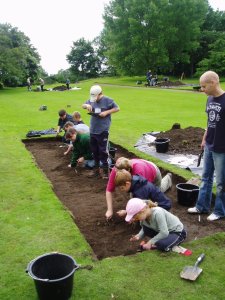
Digging at Boarstall Tower with the National Trust
national network of Young Archaeologist’s Clubs that are supported by the Council for British Archaeology. They provide an opportunity to learn more about a subject that’s not taught in schools but that kids are often fascinated about.
We’ve had a pretty steady group of volunteer leaders over the years, with some very useful additions recently. We’re all active in archaeology in some way or another and we’ve got a great range of skills, from a Historic Environment Record Officer, buildings and landscape archaeologist, an artefact specialist, a geophysicist to a professional digger.
Our members are very loyal and we get around 10-15 regular attenders, and we’re welcoming new members every month. We meet one Saturday morning each month and usually have a theme each year. In 2015 we planned a test-pit excavation in a willing volunteer’s garden, dug the test-pits and then researched and wrote up the findings. In 2016 we’re doing a year learning about ancient technology and have done pottery making, weaving, food technology, fire making and we plan to do bronze-casting and arrow-making.
The most rewarding thing about it is seeing members from the age of 8, when they can first attend, grow up with us and stay with us until they turn 16, when they can become a volunteer helper and stay with us until they go to university (hopefully to study archaeology!), or when the ones who are sometimes the most difficult to engage get really stuck in with an activity and when members really shine by presenting their work to their parents and local archaeologists.
In 2016 I undertook some market research for the Pitt Rivers Museum’s Need, Make, Use project in advance of a new permanent display of some of the archaeological collection that is otherwise not very obvious in the museum; anthropological items are the majority of items on display. The objective was to gauge the interest and background knowledge of family visitors to the museum about archaeology to inform the design of the redisplay.
The desk-based section of the work involved researching what other museums had done with their archaeological collections. It was really interesting to read about and talk to curators about some of the decisions they had taken about the themes and stories they wished to bring out from the archaeology, and why specific items that had been chosen for display. Grace Todd at the National Museum of Wales in Cardiff was very helpful, explaining the thinking behind their Adventures in Archaeology exhibition. It was centred around props from the latest Indiana Jones movie, using this as a basis to explore real archaeological adventurers. Themes they wanted to get across were that early archaeologists were not necessarily trained as such but had other backgrounds, that archaeology can be discovered by anyone today, but conversely that archaeology is a skilled profession. Each case was centred around one ‘wow’ object that caught the eye.
The Museum of London had tried out putting modern objects that performed a similar function to their Roman counterparts on display in the same cases to test whether it would help understanding about life in Roman London. The results were mixed. Some visitors were aggrieved to have modern objects in a Roman display, while many teachers felt it helped their children identify with Roman Londoners. At Manchester Museum the Egyptian gallery starts with a ‘cabinet of curiosities’ style display and has visible storage, both of which could be used to describe the Pitt Rivers display policy, but matched it with digital technologies, touchable objects and 3D projections to make it more accessible for families.
Deciding how to display objects on the family consultation day
The second part of the project involved consultation with families and young people. Family visitors at half-term, parent volunteers at a focus group and the museum’s resident Young Archaeologists Club (YAC) were the targets. The feedback was very interesting. Despite the YAC group’s prior interest in archaeology, the jargon that could be used in archaeology displays was little understood. At the National Museums of Wales in Cardiff, this kind of result had been anticipated, but instead of taking out jargon words, they made sure they were explained.
Timelines were tricky without help, and a visual method of orienting the objects in time was requested by all participants. The Pitt Rivers policy of grouping objects by function rather than period or place was questioned on numerous occasions, though conceded by some that it brought up interesting contrasts as long as objects were clearly labelled. The plan for the archaeology displays was instead to group objects by material. When asked to create their own display of objects, families preferred to group by theme e.g. the domestic world, clothing than anything else.
Families were virtually unanimous that images could give context to the objects, either showing how they were made or used, and several suggested embedded video in the cases, something that’s never been done before in the permanent galleries at the Pitt Rivers Museum. A little information for adults to read to help interpret displays for their children was also requested, but just a little.
The Need, Make, Use blog shows the process of choosing pottery for display in the new archaeology cases, and I think they are going to be as packed as always. I look forward to seeing the final displays unveiled.
References
Hicks, D & Stevenson, A. 2013. World Archaeology at the Pitt Rivers Museum: a characterization. Oxford, Archaeopress.
Morris Hargreaves McIntyre, 2012. Breathing new life into Roman London: Summative evaluation of Our Londinium at the Museum of London. Manchester.
Weeks, J 2013. Ancient Worlds, Manchester Museum. Museums Journal Issue 113/02, p42-45.
I’m very lucky to have family in New Zealand and so have managed to visit the beautiful country several times. With me and my husband both working in the heritage business, we tend to sample the museums, archaeological sites and historic houses alongside the natural beauty and Lord of the Rings attractions.
We haven’t seen them all, by any stretch (we’ve never managed to get to the South Island), but we have visited the museums in Auckland, Rotorua and, this time, we managed to see Te Papa in Wellington. Some of the earliest European houses in New Zealand are in the Bay of Islands, which we also explored.
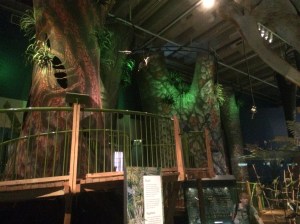
Inside the natural history gallery at Te Papa
Te Papa in Wellington explores the heritage of the islands, both Maori and European, as well as the natural history of the archipelago. I was very keen to see the museum as it’s well known for its work with the local community. Children’s voices were used to interpret the natural history displays, and there was a great deal of input into the displays by iwi (Maori tribes). We were there during term-time and we saw a kindergarten group come in to find out about native wildlife, and some high school kids were enjoying the house in a simulated earthquake.
An oven at Te Wairoa that was buried by the eruption of Mount Tarawera
Rotorua Museum also has a fantastic display of Maori history and cultural objects, including a display on their contribution to the First and Second World Wars. The museum is housed in the old Bath House and some of the rooms are preserved from its heyday. As Rotorua is a volcanic area, there are many spas where you can safely take advantage of the hot pools and bubbling mud. Up in the hills south of the city are the remains of a several buried villages, Te Wairoa, for instance, that were destroyed in the eruption of Mount Tarawera in 1886, and there’s an account of this in Rotorua Museum.
Auckland War Memorial Museum sits on the top of an extinct volcano in the Auckland Domain park. It has an amazing collection of not only New Zealand treasures but also of the Pacific islands. Maori culture is represented by wonderful meeting houses and canoes among other things.
Te Whare or meeting house at Waitangi
Russell Museum in the Bay of Islands is a very cute museum with a scale model of Captain Cook’s ship, as well as social history objects of the earliest European settlement in new Zealand. Despite being very remote now, at one point it was the colonial capital of the islands.
Further up the bay are the Waitangi Treaty Grounds where the treaty between the British Government and the Maori iwi was first signed in 1840. It had already been a meeting place for the Ngapuhi people before Europeans arrived. An early government building exists on site, and a century later a Maori meeting house was also built.
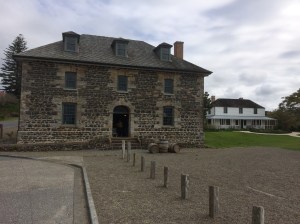
Stone Store in the foreground and the Mission House at Kerikeri in the background
Some of the oldest European buildings in New Zealand are in the Bay of Islands, including the Mission House, built in 1822, and Stone Store at Kerikeri, which was built to store grain before it was realised that wheat would not grow in New Zealand. They were built across the river from Kororipo pa, a fortified Maori site, which was still in use when the European houses were first built.
Te Waimate Mission House is further inland. I was particularly keen to go there as it was visited by Charles Darwin on his round the world voyage in 1835. He actually spent Christmas there, but didn’t take to New Zealand. On this point I disagree with him entirely.
I’ve been lucky enough to have been doing some guided tours again recently. I was a tour guide at Hampton Court Palace for four years back in the noughties and have dabbled with guiding on and off since, and have trained others in good tour-guiding techniques at the Royal Mews, the V&A and the Pitt Rivers Museum.
Me at Acton Court
Mainly my tour guiding experience has been indoors, such as in Acton Court near Bristol, which is a wonderful survival of a house built especially for one of Henry VIII’s progresses in 1535. This was a gift of a job as the house was only accessible by tour, meaning there were no other visitors milling around making noise, we could take over the whole room wherever we stopped and there was virtually no furniture in any of the rooms, making each of them spacious enough for large groups. While the rooms were bigger at Hampton Court for the most part, there was an extra need to consider other visitors and not take up too much space while, at the same time, having much bigger tour groups.
This time I have been tour guiding on a bus and outdoors and instead of a tour being only an hour at most, this tour has taken the whole day, albeit with large breaks in between for informal chat, lunch or naps! I’ve been helping out a company called Tours from Antiquity which runs bus tours to Stonehenge and Avebury. The tour buses are small and the clientele are super-interested, dedicated to spending a whole day immersed in Stone Age archaeology. Of course, the big difference between this way of working and what I’ve done before is that I haven’t been guiding in period costume. I’ve had to think hard about what to wear every day!
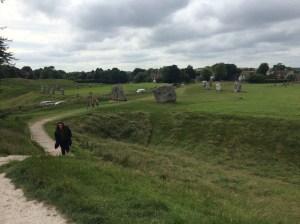
Avebury stone circle and henge
Talking outside is obviously different and, on the whole, more difficult than talking inside. The group spread out more, the wind can take my voice, and there is often the sound of traffic to compete with. At Stonehenge there are other visitors to consider, though we get there very early when its quiet, while at Avebury and other sites this is not so much of a problem. I do what I usually do to be heard, face the group, stand comfortably so that I can comfortably project my voice, make sure I have eye contact with everyone.
Stonehenge
What’s more difficult is crafting a tour that seeds ideas at the start of the day that can be linked back to at various points and weaving threads throughout that can be tied up at the end. I hate having a collection of unrelated facts in a tour. What makes the information memorable and meaningful is a narrative. This is difficult when one of the stops on the tour is Bath, but luckily even that Roman and Georgian town has a link back to Stonehenge. The Circus was designed by an early antiquary and architect, John Wood, who built thirty doors for the thirty sarsens in the stone circle at Stonehenge, and one of the roads that radiates from the Circus, Bennett Street, is aligned on midsummer sunrise.
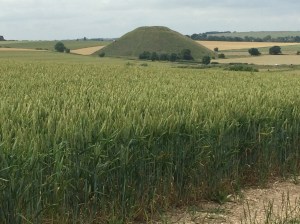
Silbury Hill from West Kennet long barrow
Having a narrative doesn’t mean that you can’t go off on a tangent or drop in the odd interesting but unrelated fact, nor does it mean that everything has to fit neatly into a specific interpretation of the evidence. I present several models of why Stonehenge, Avebury and Silbury Hill were built and how they were used. It’s interesting to note the vistas from each, though, the alignments on midsummer sunrise and midwinter sunset at Stonehenge, the view from Avebury to Silbury Hill and out from the cove vaguely towards midsummer sunrise, and the connected theme of movement around the landscape with the avenues from Durrington Walls to the Avon, the Avon to Stonehenge and back, and the avenues from (or to) Avebury to the Sanctuary and the Beckhampton enclosure and cove. I also have a second narrative alongside the first, the development of technology and techniques in archaeology and the way archaeology is done.
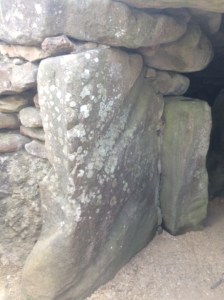
Axe-polishing stone set in the entrance of West Kennet long barrow
I can go into so much more depth and explore some very complex ideas because of the investment and commitment of the tour group and the length of time we have together. We talk about the attitude towards the past in prehistory at West Kennet long barrow where an axe-polishing stone has been incorporated into the tomb’s chamber which had clearly been used for some time and had a heritage of its own. I theorise about the change in religious ceremonies from honouring the ancestors to worshipping the sun. I explain the Early Bronze Age Wessex culture boom and bust.
Also, the informal chats in between the formal tour allows reflection and clarification, and lets me get to know more about members of the tour personally and find out if they have any personal interests that I can address. One was more interested in archaeoastronomy, a retired physics professor was interested in geophysical methods, an author wanted to know about how people lived. Finally, the tour finishes at the only pub inside a stone circle in the world and we share a beer and laughter at the end of a great day exploring some of the most iconic prehistoric sites in Britain.
I often think of what types of sources are used to make the stories about the past on various dodgy websites. Since I’ve been working for the Hamilton Trust I have become more aware of how many websites and books offer information and resources for teachers that don’t quote where they got their information from (even the BBC). Of course, many primary school teachers will not have studied history past the age of 14 themselves, so will not know the information, let alone have the historical skills to find out.
Not only do teachers often not know and don’t have time to find out where the information comes from, how can children (and I quote from the national curriculum) “understand how our knowledge of the past is constructed from a range of sources” if the teachers have no idea? Critical thinking skills get such high billing in the science or English curriculum, they should be there in the history curriculum too.
I tend to write blocks of work on the evidence behind the various topics I write about e.g. the Shang Dynasty of China, Ancient Greece or, currently, Benin in West Africa from AD 900-1300. I built in a discussion about sources for prehistory in the workshop I developed for the Pitt Rivers Museum (particularly as it is an anthropology museum and I wanted to show that ethnographic parallels are a frequently used, if sometimes contested, alternative source of evidence to interpret archaeological sites and artefacts). When I go out to schools to talk about Anglo-Saxons I get kids to act out the invasion according to Bede, and then pick holes in the evidence as provided by archaeology.
I have found writing about the sources of evidence for Benin’s pre-colonial history quite a challenge. Websites and books merely told the stories of various Ogisos and Obas, and the possible invasions from Ile-Ife that either they got from another website or book without references, or they assumed you knew what the main sources were.
Finally, I found several almost primary sources. Firstly, those stories about the Ogisos and Obas come from the oral histories that were told for centuries in Benin (now in south-west Nigeria, not the site of the current Republic of Benin) and written down and published in 1933 by Jacob Egharevba. If you have an account with Questia, you can read it online. But how far can we trust the oral histories that may have been reworked several times?
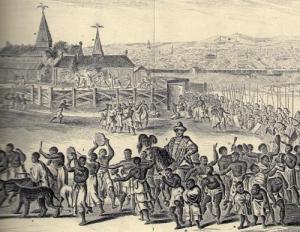
Benin City by D O Dapper, Public Domain, via Wikimedia Commons.
Secondly, there are the accounts by Europeans about what Benin was like after the period in question. There’s Olfert Dapper who published in 1668 (and hadn’t visited so based all his information on reports from others), Olaudah Equiano claimed to have grown up in Benin before being sold into slavery at the age of 11, but he may have been born in the Americas, and Sir Richard Burton wrote about the kingdom and other areas of West Africa during a journey in 1862. But what can the writers of these later centuries tell us of the pre-European period? Surely the mere contact with Europeans changed the society hugely, plus it’s written by outsiders who have particular agendas.
Thirdly, there’s archaeology. Not a lot of archaeology has been done in the kingdom of Benin but there is one article I found in the The Journal of African History by Graham Connagh dating back to the 1960s where he dug on the site of the former Oba’s palace and some of the levels dated back to the 13th century AD (you can find it on JSTOR). But I didn’t find any other articles on the archaeology of the kingdom of Benin. Do please point me their way if you know of any!
Having taken the teachers and children through these various sources of evidence, I am challenging them to recreate Benin City using the various sources. Here’s my recreation of part of the Oba’s palace based on one of the Benin bronze plaques now in the British Museum below.
Children will have to decide whether to focus on pictorial evidence, written descriptions or archaeological discoveries, especially where they contradict each other. It’ll be interesting to see whether any of them think about focusing on one particular time in the Kingdom of Benin’s history. The evidence I have provided for this task ranges from the 12th to the 19th centuries AD. Did the city stay the same during this period? I hope there’ll be plenty of discussion (perhaps even arguments) about the reliability and validity of the evidence as classes build their models of Benin City.
In 2006 two metal-detectorists found a hoard of Roman coins near Milton Keynes. Archaeologists were notified and the site was excavated, and it was thought that the coins were probably buried in a pot in a rubbish heap. The coins were not particularly valuable, they were all bronze, but there were 1456 of them. They were reported as treasure the are no in Buckinghamshire County Museum.
What is fascinating about these coins is the story they tell. The coins date to the 4th century AD, mostly around AD 350. There are a couple of coins of Constantine the Great (the emperor who made Christianity the state religion of the Roman Empire) but many more from the reign of his sons, Constantine II, Constantius and Constans (Roman emperor’s baby name books weren’t very imaginative).
A century before this the emperor Diocletian reorganised the empire into two zones, the Western and the Eastern Empires. There was an over-emperor or Augustus who generally controlled the Eastern Empire and a junior emperor or Caesar who controlled the Western Empire. When Constantine the Great died, his three sons split the territories between them. They bickered, though, as you’d expect, and it eventually came to blows. In a battle between Constantine II and Constans, the former was killed.
Things stabilised for a while, but then Constans is said to have got very cruel and preferred the company of his barbarian bodyguards that his generals. One of these, a man called Magnentius (who is said to have had a Frankish mother and a British father) decided to make himself Augustus and Caesar and sent someone to dispatch Constans.
Eventually, Magnentius and the one surviving son of Constantine the Great, Constantius, fought. Their armies met in Dalmatia and in Frankia and eventually Magnentius was defeated and he killed himself. Constantius is supposed to have sent a servant called Paulus to Britain to punish anyone who supported Magnentius, and he got the nickname Paulus Catena or Paul the Chain for dragging people through the streets in chains.
The coins in the pot found by the metal-detectorists near Milton Keynes in 2006 were mainly coins of Constantius, Constans and Magnentius. Perhaps the owners of these coins buried them in a panic generated by Paulus Catena’s antics.
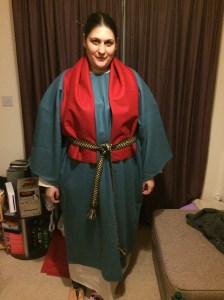
Me at home in my late Roman outfit
Brett Thorn at the Buckinghamshire County Museum asked me to write some teacher’s material to go with the coins as part of a tour of part of the hoard to schools in Milton Keynes. I was also to devise a session where I would go in to the school in costume and let kids handle some coins from the hoard.
I did my first one yesterday, and it went really well. We told the very complicated story of the rebellion and burial of the coins in the hall, along with cardboard swords, laurel wreaths, purple robes and paper chains. I involved every single child from two classes in telling the story, which helped bring it to life. Later the kids remembers which friends had been Magnentius, Constans and the others.
Cardboard swords
Paper chains
The kids loved handling the coins, and already knew that they had to wear gloves to protect the coins from the acidic oils on their hands. I worked with a small group at a time to handle the coins, and took some Roman games to try out for the rest of the class to play while they waited.
Last year I finally decided to get the tattoos I had wanted for ages. It’s a big step, to commit to letting someone permanently mark your skin, but as I nervously brushed my teeth that morning I caught sight of the little crossed scars that I bear on my stomach from a couple of laparoscopies. I had not particularly wanted those marks on my body, but they were there. It was time I chose what was emblazoned into my skin.
It was Ötzi who sealed my fate as an archaeologist when he was discovered in 1991. At the same time as I was enthralled with Robin Hood: Prince of Thieves, I was amazed by the incredible preservation of this man from the Alps, down to his tattoos and even pubic hair. Now, Ötzi has 61 separate tattoos, apparently, and I was never going to recreate them all, particularly as many would be on areas of my body that never see the light of day. So I chose three sets that I could most easily show to people.
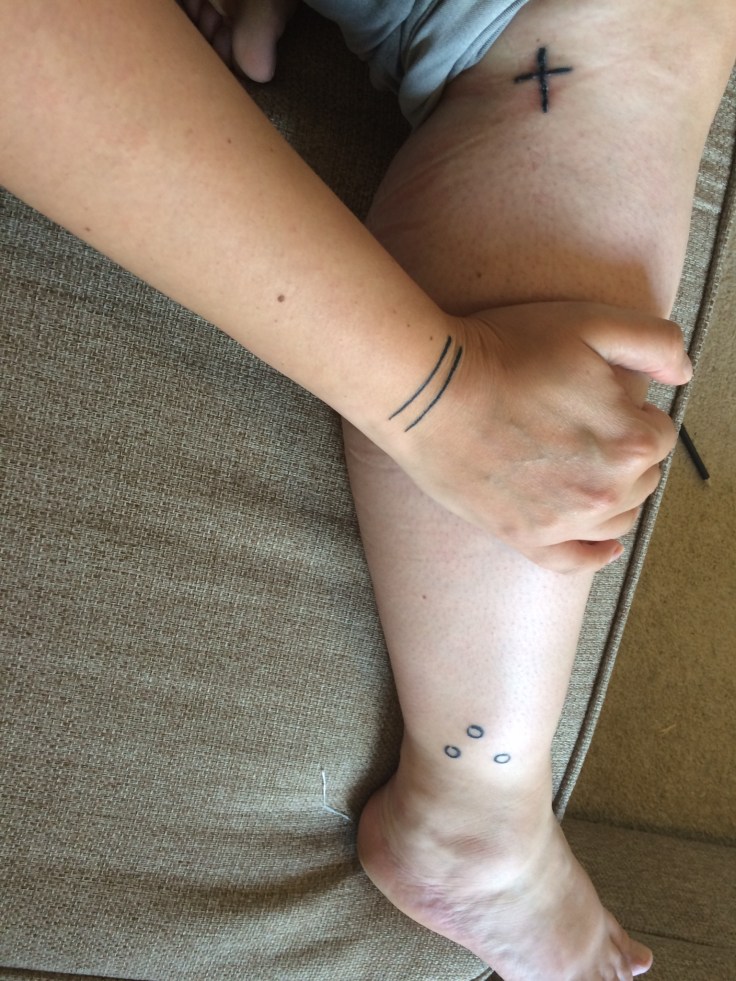
There are two rough lines on his right wrist that some have suggested are not tattoos at all but the marks of a tight band wound round his wrist, but if that’s the case, why are they just on the upper surface of the arm? Then I chose a cross on the outside edge of my knee joint and three circles on my ankle. Ötzi actually has two but I decided on one circle for every member of my immediate family.
One of the most fascinating things about Ötzi’s tattoos is that many of them fall on acupuncture points that are used to relieve joint pain. Sure enough, from x-rays of his bones, the tattooed joints seem to suffer from osteoarthritis. So the tattoos were medicinal. This is how I interpret my tattoos to children and adults alike when I dress as a prehistoric person. I am my own replica object.
 The British Museum was commissioned by the Department for Education to create resources for the new history curriculum at Key Stage 2 and 3, Teaching History in 100 Objects. The format was similar to the radio series by the museum’s director, Neil MacGregor, A History of the World in 100 Objects. In reality these 100 objects were just jumping off points for finding an infinite array of objects to use in the classroom.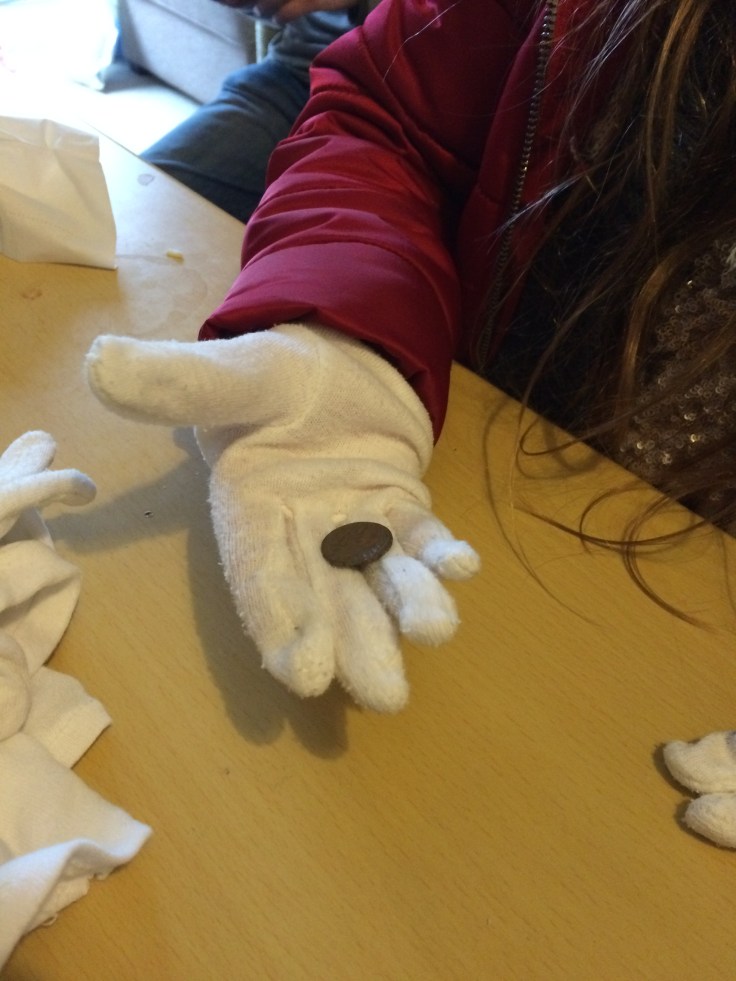



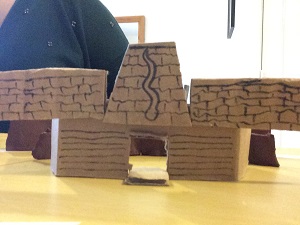 sources. Here’s my recreation of part of the Oba’s palace based on one of the Benin bronze plaques now in the British Museum below.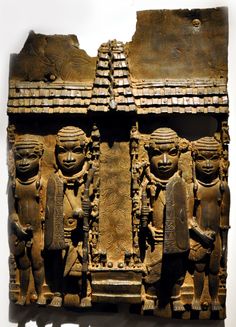


 kim biddulph